
Leading by example in the global fight against climate change, the Government of Canada is transforming how buildings are heated and cooled in the National Capital Region (NCR) through the Energy Services Acquisition Program (ESAP). By 2026, this modernization will make the District Energy System (DES) one of the greenest of its kind in North America.
As one of North America’s first conversions of a large public district energy system, transitioning from steam to low-temperature hot water (LTHW) for heating and electric chillers for cooling, ESAP represents one of the Government of Canada’s most impactful initiatives to reduce GHG emissions from its operations.
Building a Safer, More Cost Effective, Low-Carbon, District Energy System
The NCR District Energy System (DES), originally built 50 to 100 years ago, relied on outdated technologies, many of which were at the end of their life cycle. To address this, Public Services and Procurement Canada (PSPC) and Innovate Energy entered a Public-Private Partnership (P3) agreement (2019–2055) to design, build, finance, operate, and maintain (DBfOM) four energy centres interconnected by 14 km of underground piping. This modernization places the NCR alongside cities like Paris, Stockholm, and Copenhagen in decarbonizing district energy systems.
Three new energy centres have been constructed in the downtown cores of Ottawa and Gatineau, while a fourth was retrofitted at the Confederation Heights campus. The NCR DES interconnects the Tunney’s Pasture, Cliff, and Gatineau Energy Centres, as well as two pumphouses. The new Gatineau Energy Centre Pumphouse, located along the Ottawa River’s north shore, provides a renewable source of cold water for cooling and features a green roof and naturalized landscape that blends with the riverbanks. A second pumphouse at Remic Rapids was modernized to supply river water to the Tunney’s Pasture Energy Centre. The Confederation Heights Energy Centre operates independently, serving only its campus.
For heating, the system was converted from high-temperature steam to low-temperature hot water, creating a safer, lower-cost, and more efficient model that significantly reduces GHG emissions. For cooling, steam-driven chillers were replaced with electric chillers, while leveraging the Ottawa River for winter cooling and summer heat rejection. This sustainable approach cuts electricity use by 30% and reduces environmental impacts.
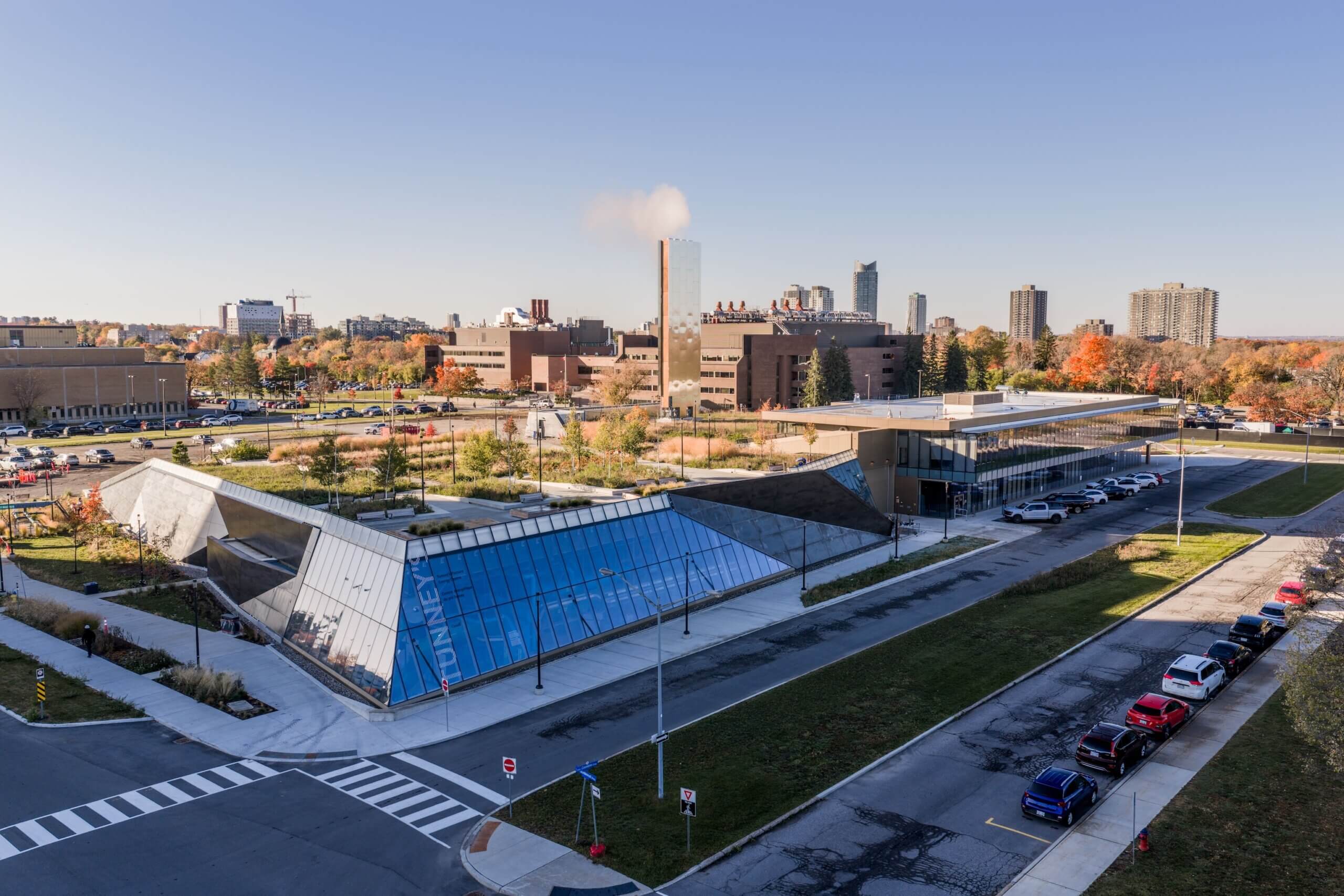
Tunney’s Pasture Energy Centre
Balanced Energy Use to Support Reliable, Efficient and Cost-Effective Services
In 2026, a balanced mix of energy sources will be used to heat and cool connected buildings, including electricity and natural gas. This flexible and balanced approach allows the system to respond to seasonal demands and deliver reliable, efficient, and cost-effective services. While this strategy may involve trade-offs in greenhouse gas (GHG) reductions, it reflects a pragmatic step toward long-term sustainability and resilience. Through ESAP, the Government of Canada remains committed to delivering low-carbon energy and supporting Canada’s clean energy future.
Leveraging Hydro Quebec’s 99% carbon-free grid
One of the most transformative moments occurred when Hydro-Québec connected its services to the NCR DES. This opened the door to tap into one of the greenest power grids in the world, leveraging 99% carbon-neutral electricity.
With that connection, new electric boilers and chillers were introduced. These upgrades replaced most of the natural gas as the system’s primary fuel source with hydroelectricity.
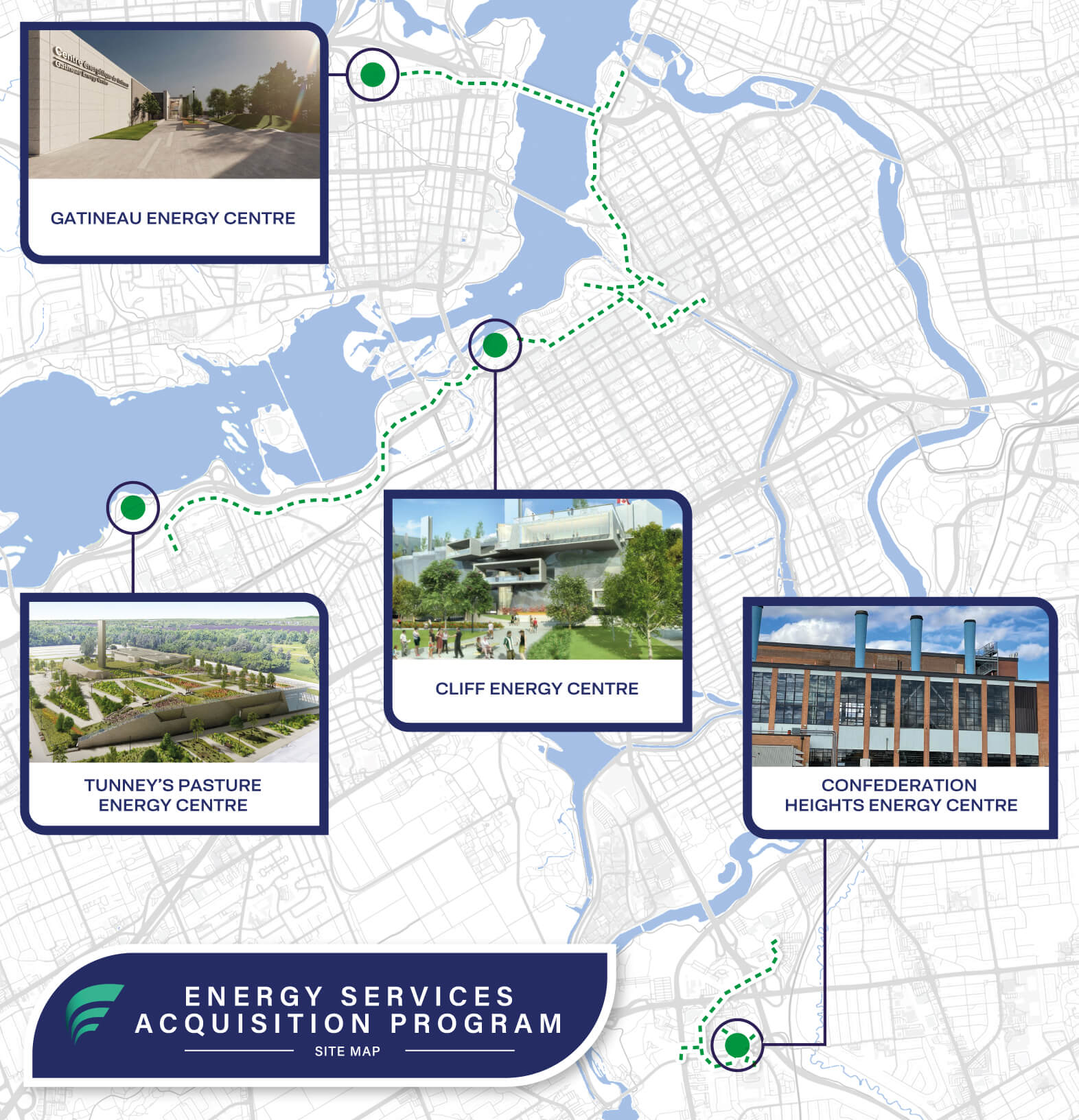
This map shows the National Capital Region District Energy System (NCR DES). The circles indicate new or modernized energy centres and the dotted green lines represent the underground network of pipes used to distribute heating and cooling to connected buildings.
Expected results of the modernization
By completing the modernization, a significant GHG reduction is expected, compared to 2005 baselines.
By 2026, the network will have 200 megawatts (MW) heating capacity and 150 MW cooling capacity. Depending on the connected building’s requirements, the system is capable of providing heating energy ranging from 4 grams-230 grams of carbon per kilowatt hour (kWh). This wide range of flexibility is a unique feature for district energy systems.
Looking ahead, the capacity for expansion, positions the program as a future-ready solution. The system is built to evolve either through:
- the adoption of emerging technologies
- the incorporation of renewable energy sources
- the extension of service to additional buildings in the NCR
This adaptability reinforces the role in supporting Canada’s clean energy transition for decades to come.
Milestones Achieved:
- 2019 - Contract signed with Innovate Energy, the P3 partner for the project
- 2020 - Innovate Energy assumed responsibility for operations
- 2020 - Start of Design and Construction
- 2025-2026 - Substantial Completion and Validation Period
- 2026-2055 - Long term operation by Innovate Energy
Next Steps:
- 2026: Finish GEC Construction
- 2026 and beyond: Assess the opportunity for adding new clients to the NCR DES