

District energy systems are recognized by the United Nations Energy Program as “one of the least-cost and most efficient solutions for reducing greenhouse gas emissions and primary energy demand.” They provide heating and cooling through centralized energy centres connected by underground pipes—using less energy and offering greater efficiency than individual building systems.
Through ESAP and Innovate Energy, Canada is setting a global precedent. As one of North America’s first large-scale conversions of a public district energy system, ESAP significantly advances the Canada’s climate commitments established under the Paris Agreement, the Greening Government Strategy and the Federal Sustainable Development Strategy which aligns with the United Nation’s 2030 Agenda for Sustainable Development.
This project positions Canada and the NCR as a leader in low-carbon buildings and green technology, with a model that can be replicated nationally and internationally; joining major cities such as Helsinki, Copenhagen, Paris, London, Berlin, Seattle, New York City, San Francisco, Vancouver, Toronto and many others.
Why It Matters
- Major GHG reductions compared to 2005 baselines
- Supports Canada’s sustainability goals well ahead of 2050
- Heating and cooling energy use reduced by 30% through efficiencies and smart technology
Benefits Beyond Energy
- Cost savings: Nearly $500 million between 2026 to 2055
- Safer, more reliable operations
- Public engagement
- Transforming spaces from “grey to green” with parks, gardens, and public spaces
- Future-ready: Scalable design for new clients and renewable energy integration
Looking Ahead
By 2026, the network will have 177 megawatts (MW) heating capacity and 152.5 MW cooling capacity. Depending on the connected building’s requirements, the system is capable of providing heating energy ranging from 4 grams-230 grams of carbon per kilowatt hour (kWh). This wide range of flexibility is a unique feature for district energy systems.
Looking ahead, the capacity for expansion positions the program as a future-ready solution. The system is built to evolve either through:
- the adoption of emerging technologies
- the incorporation of renewable energy sources
- the extension of service to new federal/private sector facilities
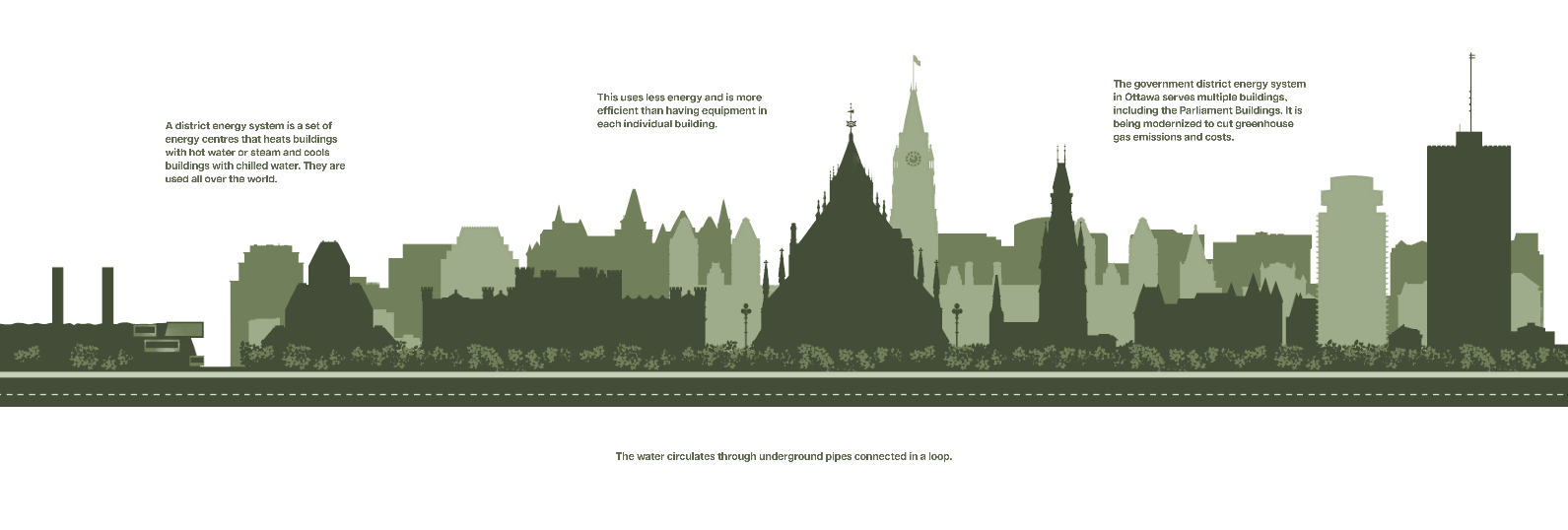
According to the United Nations’ Energy Program, DESs are “one of the least-cost and most efficient solutions for reducing greenhouse gas emissions and primary energy demand.”